
I’ve tested more motorcycle gear than most riders will see in a lifetime.
You’re probably tired of choosing between protection that feels like armor plating and comfort that leaves you vulnerable. Most gear makes you pick one or the other.
Here’s what I know: you shouldn’t have to compromise. Not on safety. Not on comfort. Not on how your gear performs when you actually need it.
I spent years on the road testing what works and what doesn’t. I’ve studied material science. I’ve talked to engineers who design impact protection. I’ve crashed (more than I’d like to admit) and learned what matters when asphalt comes at you fast.
This guide shows you exactly what to look for in fmbmotoapparel motorcycle gear by formotorbikes and beyond.
You’ll learn which features actually protect you and which ones are marketing speak. What materials hold up after thousands of miles. How fit affects both safety and comfort in ways most riders don’t think about.
No fluff about lifestyle or image. Just what you need to know before you spend money on gear that might save your skin someday.
What Separates Enthusiast Apparel from Standard Gear?
You’ve probably noticed it at bike nights.
Some riders show up in gear that looks like it’s been through a war and still performs. Others replace their stuff every season because it falls apart.
What’s the difference?
It’s not just about spending more money. I’ve seen expensive gear fail and budget options hold up. The real separator is what goes into the construction.
Enthusiast-grade gear operates on three core principles.
First is uncompromised safety. We’re talking CE-rated armor that actually stays in place during a slide (not the kind that shifts around in the pocket). Abrasion-resistant materials tested to specific standards. The difference between road rash and walking away clean.
Second is all-weather performance. Waterproof membranes that breathe. Ventilation systems you can adjust on the fly. Because you don’t stop riding when the forecast changes.
Third is rider-focused ergonomics. Pre-curved sleeves that don’t restrict movement. Stretch panels where you need them. Gear designed around how you actually sit on a bike, not how you stand in a fitting room.
Here’s what most people miss about quality fmbmotoapparel motorcycle gear by formotorbikes.
It’s not an expense. It’s an investment that pays you back every time you ride. Better protection when things go wrong. More comfort when they go right. And gear that lasts years instead of months.
The math is simple. Buy once, ride confidently.
The Anatomy of a Modern Riding Jacket
You probably think all riding jackets are basically the same.
Throw some armor in a leather shell and call it a day, right?
Wrong.
Modern riding gear has changed more in the past five years than it did in the previous twenty. The jackets you see today use materials that didn’t even exist when I started riding.
Let me break down what actually matters.
Material Science That Works
Cordura and Kevlar get thrown around like buzzwords. But here’s what they actually do.
Cordura is a nylon weave that resists abrasion better than most materials at its weight. It’s lighter than leather and doesn’t need the same break-in period. Kevlar takes it further with cut resistance that’s hard to beat.
Performance leather still has its place though. Modern tanning processes create hides that breathe better and move with you. Some manufacturers now build hybrid jackets that put Kevlar panels in high-impact zones while using leather everywhere else.
That combination gives you the best of both worlds without compromise.
The Armor That Actually Protects You
Basic foam pads are better than nothing. Barely.
Real protection comes from materials like D3O and SAS-TEC. These aren’t just thicker foam. They use non-Newtonian polymers that stay flexible until impact, then instantly harden to absorb energy.
CE-Level 1 armor meets minimum standards. CE-Level 2 cuts impact force transmission nearly in half. For your back, shoulders, and elbows, that difference matters when you’re sliding across pavement at 40 mph.
I always spec Level 2 for anything protecting my spine.
Climate Control You’ll Actually Use
A jacket that only works in one season sits in your closet most of the year.
Look for removable thermal liners you can zip out in spring. Direct-to-body vents (not just mesh panels) that actually move air when you’re stuck in traffic. Waterproof membranes like Gore-Tex that keep you dry without turning your jacket into a sauna.
The fmbmotoapparel motorcycle gear by formotorbikes approach focuses on this kind of year-round functionality.
Features That Matter on Real Rides
Waterproof pockets keep your phone alive in a downpour. Jacket-to-pant connection zippers stop your gear from riding up when you’re tucked in. Reflective detailing makes you visible to that driver who’s scrolling Instagram at a red light.
These aren’t extras. They’re the difference between gear you wear and gear you wish you’d bought instead.
Helmet Technology: Your Most Critical Piece of Gear
You can skimp on a lot of things when you ride.
Your helmet isn’t one of them.
I’ve seen riders drop serious cash on exhaust systems and LED strips but grab a $60 lid off the clearance rack. That’s backwards thinking, and honestly, it’s dangerous.
Here’s what most people don’t understand about helmet safety ratings.
DOT certification is the bare minimum in the States. It’s self-certified, meaning manufacturers test their own products. ECE (Economic Commission for Europe) is stricter. Independent labs do the testing, and they check multiple impact points.
But ECE 22.06? That’s the new standard as of 2022. It tests rotational forces, not just linear impacts. Because when you go down, your head doesn’t just hit straight on. It twists.
Now let’s talk about what your helmet is actually made of.
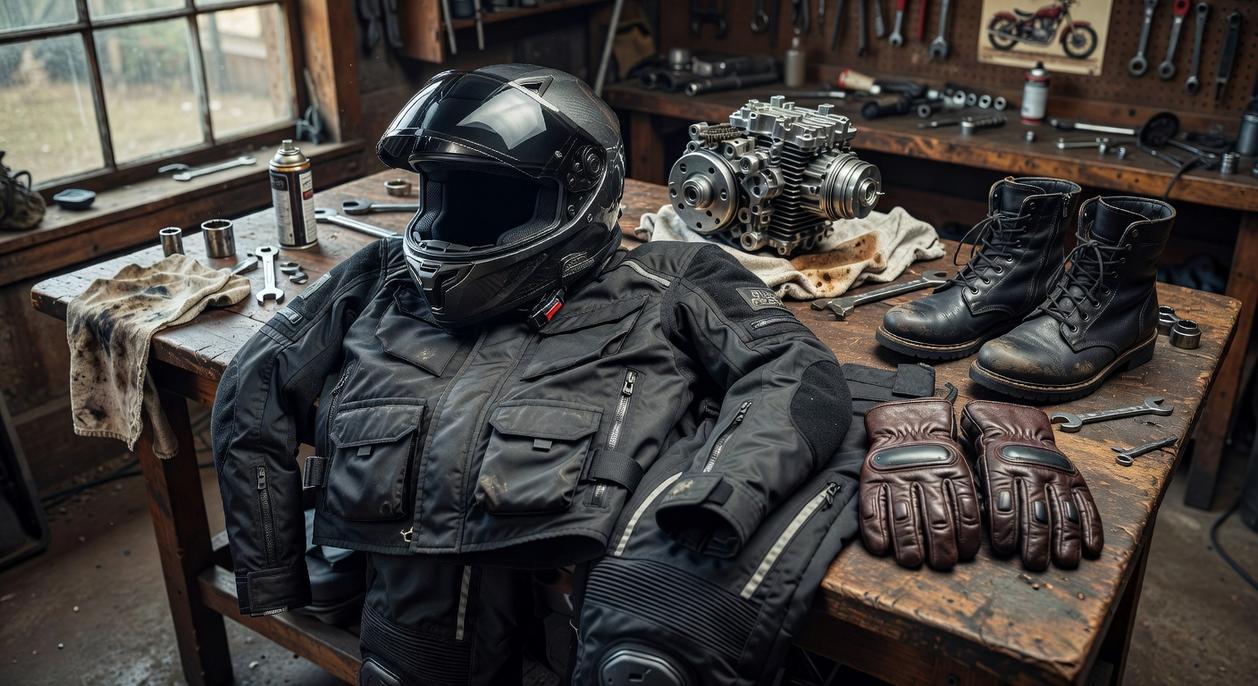
Polycarbonate shells are budget-friendly and they work. They’re heavier though, and they don’t absorb impact quite like the premium stuff. Fiberglass gives you a better strength-to-weight ratio. Carbon fiber takes it further with serious weight savings (you’ll notice after a few hours on the highway).
Some manufacturers mix Kevlar into composite shells for extra penetration resistance. Is it overkill? Maybe. But I’d rather have it and not need it.
The tech inside modern helmets has come a long way too. Built-in sun visors drop down when you need them. Pinlock-ready shields mean you’re not riding blind when temps drop. Speaker cutouts let you run communication systems without butchering your padding.
Speaking of padding, fit is everything.
A helmet that moves around on your head won’t protect you properly. Period. Your head shape matters here. Some brands cater to round oval heads, others to long oval. Try before you buy if you can, and don’t be afraid to swap cheek pads for a custom fit.
Just like how to choose motorcycle pants fmbmotoapparel, getting your helmet right takes some homework. But it’s worth it.
Your brain only gets one shell. Make sure the outer one counts.
Completing the Kit: Advanced Pants, Gloves, and Boots
You’ve got the helmet sorted.
Maybe you picked up a decent jacket too.
But what about everything else?
Here’s what I see all the time. Riders spend good money on upper body protection and then throw on regular jeans and sneakers. They figure it’s fine for short rides or around town.
Is it though?
Think about what happens in a slide. Your hands hit first (trying to catch yourself). Then your hips and knees. Your feet get dragged along asphalt at whatever speed you were going.
Regular clothes don’t stand a chance.
Some people argue that full gear is overkill for casual riding. They say you can’t live your life wrapped in armor. That riding should feel free, not restrictive.
I get where they’re coming from. Nobody wants to suit up like they’re heading to a track day just to grab coffee.
But here’s what that thinking misses.
Modern riding gear has changed. We’re not talking about stiff leather chaps and clunky boots anymore.
Riding Pants That Actually Work
Riding jeans look normal now. You can walk into a restaurant and nobody knows you’re wearing aramid fiber reinforcement in the seat and knees. The good ones come with CE-rated hip and knee armor that you can remove when you’re off the bike.
Textile pants go further. They add waterproofing and ventilation. Some have armor in places you didn’t know you needed it.
Leather pants? Still the gold standard for abrasion resistance. But only if you’re willing to commit to the look.
Gloves That Save Your Hands
Have you ever looked at your palms after catching yourself from a simple trip?
Now imagine that at 30 mph.
Palm sliders spread impact force. Hard knuckle protection keeps your fingers from bending ways they shouldn’t. The trick is finding gloves that do all this while still letting you feel the clutch lever and work your phone at a gas stop.
I won’t ride without gloves anymore. Not after seeing what happens to people who do.
Boots Built for Riding
Regular boots might look tough. But they’re not designed for the specific ways motorcycle crashes damage feet and ankles.
Riding boots have torsional stiffness. That means your ankle doesn’t twist and snap when your bike goes down on your leg. They have reinforced shifter pads so you’re not wearing through the leather in three months. The soles are designed to grip pegs, not just pavement.
You don’t need race boots for street riding. But you do need something purpose-built.
| Gear Type | Key Protection | What to Look For |
|————–|——————-|———————|
| Riding Pants | Hip and knee armor | Aramid fiber, CE-rated armor, abrasion zones |
| Gloves | Knuckles and palms | Palm sliders, hard knuckle guards, touchscreen compatible |
| Boots | Ankles and toes | Ankle support, shifter pad, oil-resistant sole |
The fmbmotoapparel motorcycle gear by formotorbikes line covers these basics without making you look like a power ranger.
Pro Tip: Buy gear that fits your actual riding. Commuters need different features than weekend canyon carvers.
Look, I’m not saying you need to spend thousands on gear before your first ride. But if you’re serious about do i need a motorbike helmet fmbmotoapparel, you should be just as serious about protecting everything below your neck.
Your future self will thank you.
Ride with Confidence, Shop with Knowledge
You came here to find motorcycle apparel that actually works.
Not the mass-market stuff that falls apart after a season. Not gear that forces you to choose between protection and comfort.
I get it because I’ve been there. You want equipment that matches your commitment to riding.
Now you know what separates enthusiast-grade gear from everything else. The materials matter. The tech features matter. The construction matters.
When you invest in the right apparel, every ride gets better. You stop thinking about your gear and start focusing on the road.
Here’s what to do next: Check out our curated collection of fmbmotoapparel motorcycle gear by formotorbikes. Find pieces that match your riding style and the conditions you face most.
The difference between good gear and great gear shows up when it counts. In the rain. On long rides. When you need protection most.
Your next ride deserves better than compromise.
 Vynovox Rune is the founder of FMB Moto Apparel, a platform focused on exploring the evolving relationship between motorcycle culture, advanced technology, and modern riding apparel. Passionate about innovation and rider performance, Vynovox created the platform to provide enthusiasts with informative coverage on smart gear, protective equipment, and emerging technologies shaping the future of motorcycling.